Algorithm for Fiscal Federalism
The problem is not North vs South but that all Indian states have limited revenue streams for their spending responsibilities.
Origin
This framework was proposed by Sarthak Pradhan and Pranay Kotasthane in a 2024 article published in ThePrint, later explored in the A Framework a Week series. It emerged from the political furore over the 2024 Union budget’s special grants to Andhra Pradesh and Bihar, which reignited long-standing apprehensions among states about fiscal allocations.
What it says
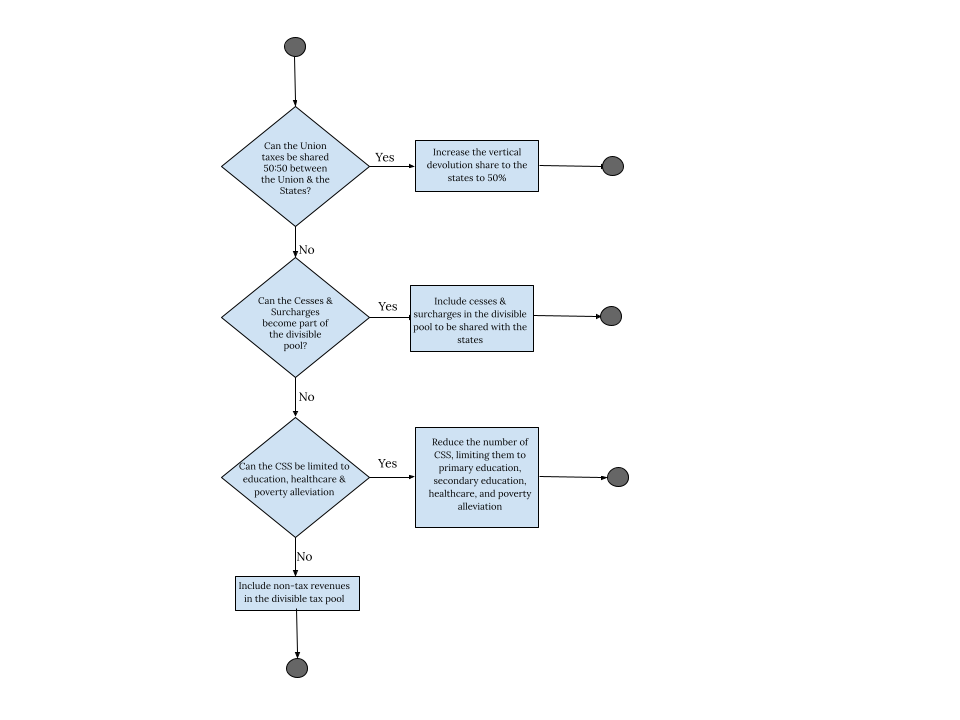
The standard debate on Indian federalism gets stuck on horizontal devolution — how to share resources between states. The more important problem is vertical devolution: how tax resources are split between the Union government and all states as a whole.
India’s Constitution assigns the most buoyant taxes (income tax, corporation tax) to the Union while allocating more spending responsibilities — education, health, police, law and order — to the states. The result is a large and growing vertical fiscal gap. The Fifteenth Finance Commission noted that the Union collects 62.7% of combined revenues while states bear 62.4% of total expenditure. States’ share in expenditure has risen by around 10 percentage points in the last three decades, but their revenue share has not kept pace.
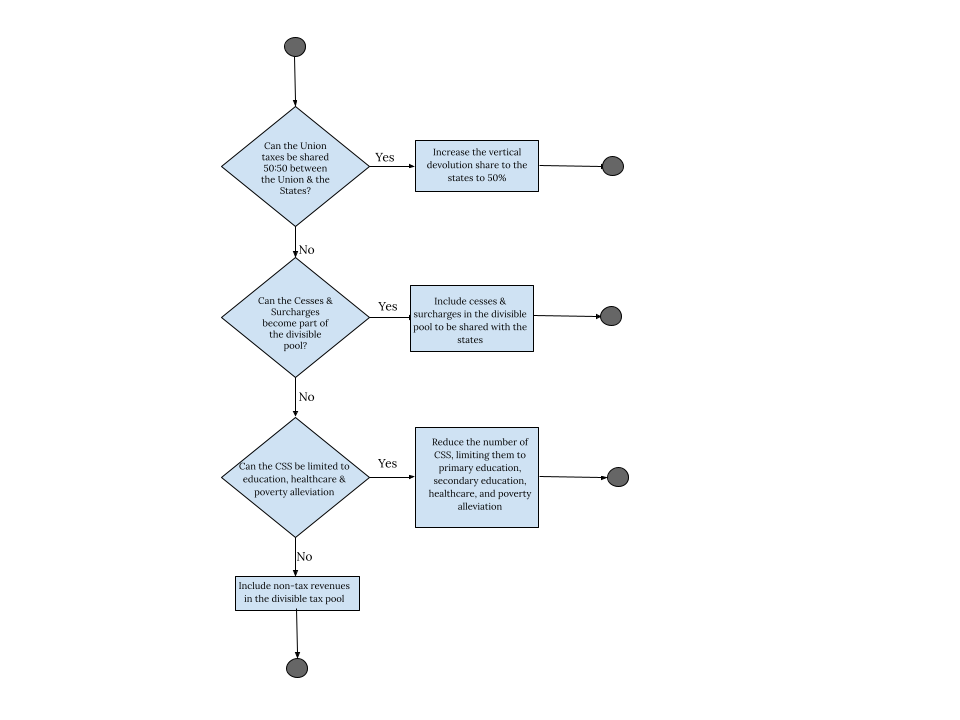
The framework proposes a decision-tree of solutions, arranged in decreasing order of fiscal benefit to states:
- Raise vertical devolution to 50% — aligning with what the current Prime Minister advocated as Gujarat CM. This would have added ₹2.24 lakh crore to states in FY 2023-24.
- Include cesses and surcharges in the divisible pool — cesses and surcharges (₹5.01 lakh crore in FY 2023-24) are not shared with states. Bringing them in would add ₹2.06 lakh crore.
- Reduce Centrally Sponsored Schemes (CSS) to core areas (education, healthcare, social assistance). CSS distorts state priorities and many states cannot provide matching funds. Limiting CSS would free up ₹1.69 lakh crore.
- Include non-tax revenues in the divisible pool — interest receipts, PSU dividends, and service charges (₹3.01 lakh crore) shared with states would add ₹1.24 lakh crore.
Applied
The 14th Finance Commission raised states’ share from 32% to 42%, but the increase did not translate proportionally into higher devolution because the Union simultaneously expanded cesses and surcharges — a fiscal manoeuvre that kept money out of the divisible pool. This is the vertical-devolution problem in action.
Karnataka’s complaint about the 2024 budget, DMK’s agitations, and Telangana’s protests about biased treatment are all symptoms of the same underlying disease: states have expenditure commitments but lack the revenue instruments to match them. The framework reframes these quarrels from zero-sum interstate rivalries to a shared structural problem.
When it falls short
The algorithm assumes political feasibility that may not exist. Raising vertical devolution to 50% would require the Union to surrender significant fiscal space, which it is unlikely to do given its own spending obligations — defence, subsidies, and interest payments.
The framework also treats all states as a bloc. In reality, poorer states have weaker absorption capacity and cannot always deploy additional funds effectively. Simply devolving more money does not automatically improve public services if state-level governance and GSDP are low.
Finally, the decision-tree does not address the political economy of specific transfers. Special-category status, discretionary grants, and politically motivated packages (like those to Andhra Pradesh and Bihar) will persist regardless of the devolution formula.
Further reading
- Pradhan, S., & Kotasthane, P. (2024). An Algorithm for Fiscal Federalism. ThePrint.
- Fifteenth Finance Commission Report, Government of India.
- Rao, M. G., & Singh, N. (2005). The Political Economy of Federalism in India. Oxford University Press.
Originally explored in A Framework a Week: Algorithm for Fiscal Federalism on Anticipating the Unintended.