A COVID-19 Vaccine Deployment Strategy for India
Vaccinating 100 crore people is a problem thirty times bigger than what India’s Universal Immunisation Programme manages annually. The sequencing problem is non-trivial for a country of India’s size and income levels.
Origin
The framework was developed by Shambhavi Naik and colleagues at the Takshashila Institution in a September 2020 Discussion SlideDoc. Pranay Kotasthane featured it in the Anticipating the Unintended newsletter as a case study in operationalising policy under extreme scale and time pressure.
What it says
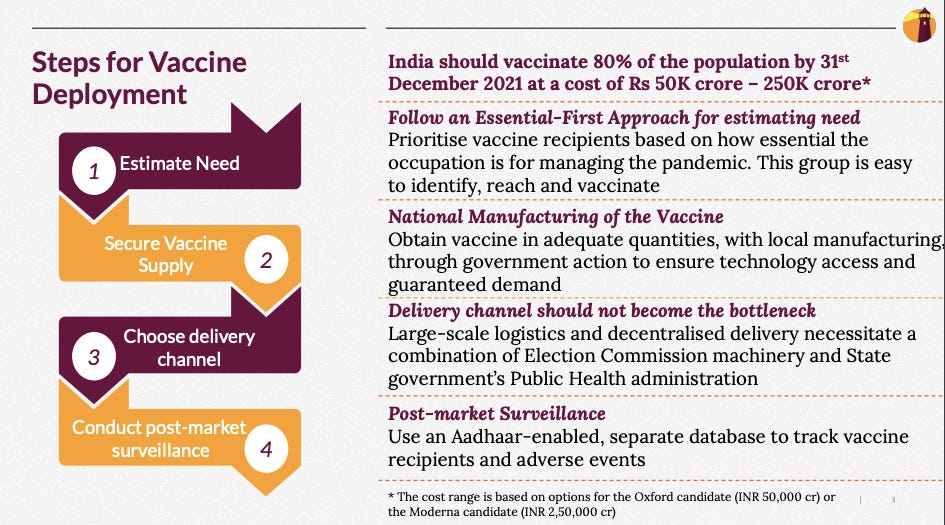
The framework breaks vaccine deployment into four interconnected challenges:
Estimate need. Prioritise a small set of essential-service recipients first, then use randomisation rather than fine-grained demographic sequencing for the mass rollout. Randomisation is simpler, faster, and fairer than age or comorbidity-based queues at scale.
Secure supply. At prevailing production capacity, vaccinating 80% of the population would take 20 months. India therefore needs diversified sourcing, technology transfer agreements, and manufacturing partnerships backed by transparent model contracts.
Choose delivery channel. Leverage the Election Commission of India’s booth infrastructure for mission-mode coverage, coordinated through state public health machinery.
Track distribution. Build a separate database — using Aadhaar and/or election ink as identifiers — to monitor vaccine flow and adverse events in real time.
The underlying principle is modular problem decomposition: break an overwhelming logistical challenge into separable workstreams, each with its own metrics, accountability, and fallback.
Applied
- When scaling any public health intervention from pilot to population — TB screening, deworming, micronutrient supplementation.
- When sourcing critical goods under supply constraint: diversify suppliers, publish contracts, and build domestic manufacturing options.
- When designing last-mile delivery for programmes that must reach every village within a compressed window.
When it falls short
The framework was designed for a specific pandemic moment; some elements — such as randomisation over sequencing — were appropriate for speed but may not suit interventions where targeting is ethically or medically paramount. It also assumes state machinery can be repurposed rapidly; in contexts where Election Commission or health administration capacity is compromised, the delivery channel choice collapses.
Further reading
- Naik, S., et al. (2020). A COVID-19 Vaccine Deployment Strategy for India. Takshashila Discussion SlideDoc.
- Original newsletter essay
Originally explored in A Framework a Week: A COVID-19 Vaccine Deployment Strategy for India on Anticipating the Unintended.