Nine Competing Visions of Equality
It is easy to say that inequality is a problem. It is far more difficult to answer what being equal means.
Origin
The framework comes from Deborah Stone’s classic Policy Paradox: The Art of Political Decision Making. Stone argues that “equality often means inequality, and equal treatment often means unequal treatment. The same distribution may look equal or unequal, depending on where you focus.”
What it says
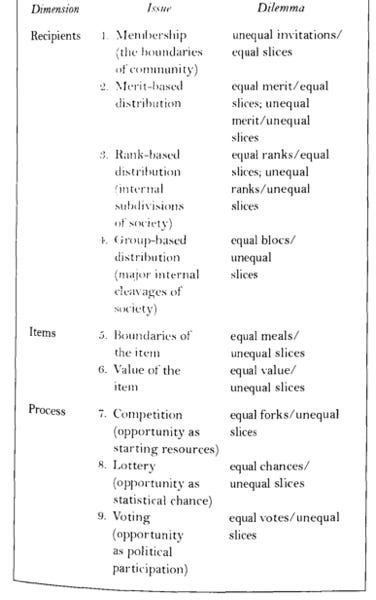
Stone identifies nine ways to distribute a resource equitably, split across three dimensions:
Who gets something? 1. Membership — equal slices among all members of a defined group. Citizenship is a membership criterion; it excludes non-citizens by design. 2. Merit — the more deserving get more. Rewards accomplishment or aptitude. 3. Rank — equally ranked get equal pay; unequally ranked get unequal payouts.
What gets distributed? 4. Group-based — distribution according to subgroup identity. Caste-based reservation is an example. 5. Expanding boundaries — redefining the item being distributed. Cash plus food, rather than cash alone. 6. Value ascribed — distribution according to how much recipients value the item.
How is the distribution done? 7. Fair competition — winners take more, but the process was open. 8. Lottery — equalising chances, not outcomes. 9. Vote — democratic decision on who gets what.
Each vision equalises along one dimension while creating inequality along another. There is no single “fairest” method — only methods that are more or less appropriate to the context.
Applied
If the Indian government plans to distribute ₹50,000 crores to 50 crore Indians, the intuitively obvious solution — ₹1,000 each — is only one of nine visions. It equalises membership (Way 1) but is unequal on merit, need, and group disadvantage. Caste reservations equalise group-based access (Way 4) but create unequal treatment of individuals within the same economic bracket.
Policymakers often default to Way 1 (equal slices) or Way 8 (lottery) when they cannot find better reasons to justify a decision. A disciplined analyst, faced with a distributive problem, should run through all nine before picking the one that best fits the moral and political context.
When it falls short
The framework is descriptive, not prescriptive. It does not tell you which vision to choose — that requires a theory of justice. In practice, political coalitions pick the vision that advantages their base and then dress it up in the language of fairness. The framework can also paralyse decision-making: if every distribution is unequal in some dimension, every distribution is contestable.
Further reading
- Stone, D. Policy Paradox: The Art of Political Decision Making.
Originally explored in A Framework a Week: Nine Competing Visions of Equality on Anticipating the Unintended.