What Global Order Are We In?
The global order is a function of both geopolitics and geoeconomics. Its intent is not to predict the future but to imagine the various possibilities.
Origin
This framework was developed by Pranay Kotasthane, Anirudh Kanisetti, Anupam Manur, and Akshay Alladi in their 2018 Takshashila Discussion Document Deriving India’s Strategies for a New World Order, and updated during the Russia-Ukraine war.
What it says
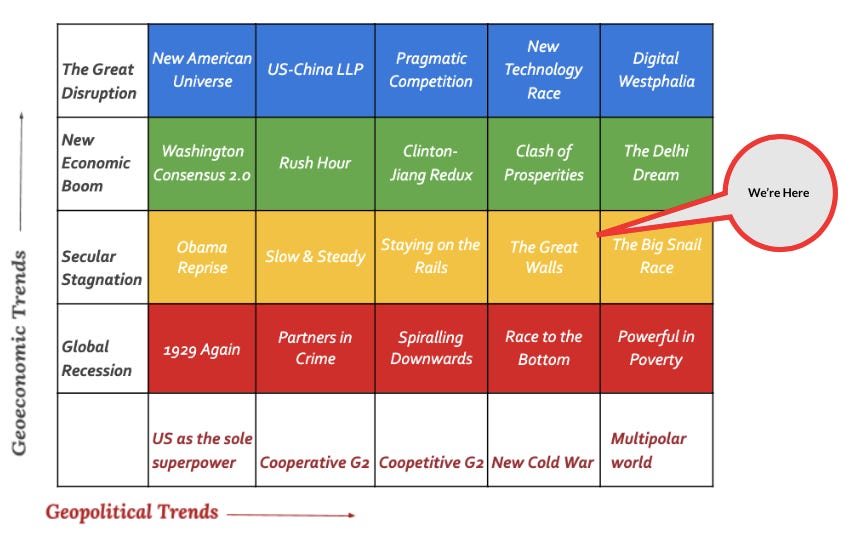
World order scenarios are at the intersection of geoeconomic trends and geopolitical trends. Rather than asking “is the world unipolar or multipolar?” — a question that misses the geoeconomic dimension — the framework maps scenarios on two axes.
Using this framework, the current world maps onto a “Great Walls” scenario: stagnated global economy plus intensifying US-China conflict.
Characteristics of Great Walls:
- Stable geopolitics, dynamic geoeconomics: The US sees countering China as an overriding priority. Reorienting supply chains leads to secular stagnation.
- From one to many economic webs: A US-dollar-led web, a China-capital-led web, and a diffused collection of middle powers striking independent bargains.
- A new age of multilateralism: Global bodies become less important; institutions organised around powerful nation-states become more important.
The Russia-Ukraine war sharpens these trends. Russia becomes more dependent on China. The West unites against Russia and China. The world does not become more multipolar; it becomes more bifurcated.
Applied
For India, Great Walls is a tough scenario. As long as the primary Western focus is countering China, India gains. As soon as the focus shifts to Russia, India is on weak footing — caught between military dependence on Russia and strategic convergence with the West.
India is pushed to strategic autonomy by compulsion, not by choice. The framework suggests investing in “small bets” — relationships and capabilities that yield option value across scenarios — rather than betting everything on a single alignment.
When it falls short
The framework is deliberately non-predictive. It does not tell us which scenario is most likely, or how long Great Walls will last. It also does not give India a clear action agenda; it is a diagnostic tool, not a strategy document.
Further reading
- Kotasthane, P., Kanisetti, A., Manur, A., & Alladi, A. Deriving India’s Strategies for a New World Order. Takshashila Discussion Document, 2018.
Originally explored in Matsyanyaaya: Where Do We Go Now? on Anticipating the Unintended.