What Makes an Asset Strategic?
The strategic level of an asset is a product of importance, externality, and nationalisation.
Origin
This framework comes from Jeffery Ding and Alan Dafoe’s paper The Logic of Strategic Assets: From Oil to AI, adapted by Pranay Kotasthane for the A Framework a Week series.
What it says
The term “strategic” is overused. Ding and Dafoe offer a precise formula:
Strategic Level = Importance × Externality × Nationalisation
- Importance: The asset’s economic and/or military utility. Freight transport contributes more to growth than high-end fashion.
- Externality: The economic and/or security externalities that uncoordinated firms and military organisations will not optimally attend to. Foundational research has positive spillovers that private actors under-invest in.
- Nationalisation: The degree to which these externalities accrue to the nation and its allies, not to rivals. Medical research has positive externalities, but they diffuse easily to rivals; semiconductor fabrication does not.
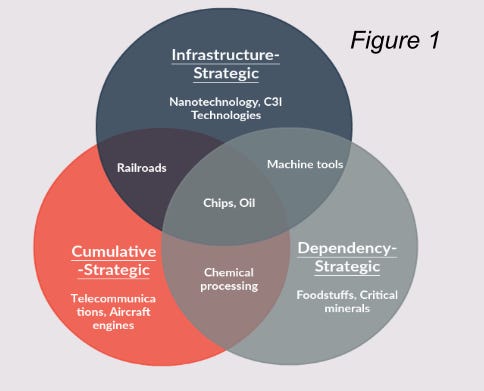
These externalities crystallise into three strategic logics:
- Cumulative-strategic logic: High barriers to entry, first-mover advantages, economies of scale. Example: aircraft engines (1945–present).
- Infrastructure-strategic logic: Assets that generate positive spillovers across the economy or military. Example: railroads (1840–1860).
- Dependency-strategic logic: Supply concentrated in limited suppliers, vulnerable to disruption. Example: nitrates during WWI.
The three logics overlap. States should pay closest attention to assets that exhibit multiple strategic logics.
Applied
For India, the framework is a prioritisation tool. Which assets qualify as strategic?
- Semiconductors: High importance, high externality (foundational technology), high nationalisation (supply concentrated in US, Taiwan, South Korea). Strong on all three logics.
- Rare earths: High dependency logic; lower cumulative logic because processing, not mining, is the bottleneck.
- AI: High importance and externality; nationalisation is contested because AI research diffuses rapidly through open publication.
The framework warns against labelling everything “strategic.” An asset is not strategic merely because it is important; it must also generate externalities that markets underproduce, and those externalities must be capturable by the nation.
When it falls short
The framework is analytical, not operational. It tells us which assets are strategic but not how much a state should invest in each, or which policy instruments (subsidies, procurement, R&D) are most appropriate. It also assumes that national boundaries are the right unit of analysis; in a world of global supply chains, even “nationalised” externalities leak across borders.