All Things Governments Do
Whenever we consider government intervention, it is always useful to know the entire range of options available — a toolkit of sorts. Given any policy problem, one should be able to go through this toolkit and ask: might this be a better way to solve this problem?
Origin
This framework draws on three sources. Vijay Kelkar and Ajay Shah, in their 2019 book In Service of the Republic, propose three pillars of state intervention: the government might produce a service, regulate private providers, or finance private consumption. Eugene Bardach’s A Practical Guide for Policy Analysis offers a second classification. A third — eight categories taught at the Takshashila Institution — rounds out the toolkit.
What it says
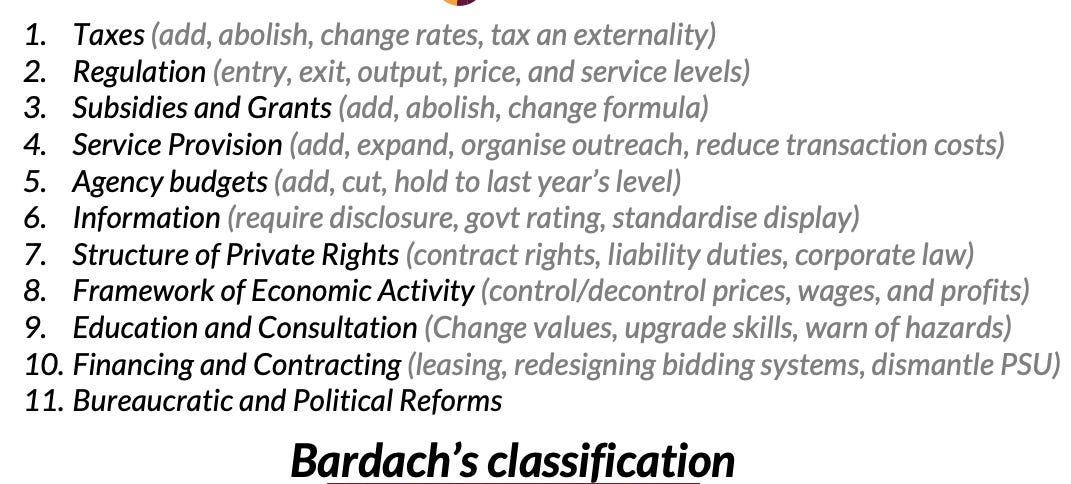
The three-pillar view maps interventions to market failures: positive externalities justify financing; negative externalities, asymmetric information, or market power justify regulating; and direct production is the fallback when neither suffices.
The eight-category toolkit is more granular:
- Do nothing
- Engage in rhetoric — shape norms and narratives without coercion
- Nudge — alter choice architecture without banning or mandating
- Umpire — enforce contracts and resolve disputes
- Marginally change incentives — taxes, subsidies, fines
- Drastically change incentives — free provision, bans, quotas
- Do it yourself — direct state production
- Change ownership — nationalisation or divestment
The discipline is to run through the list before defaulting to the most heavy-handed option. Each step up the ladder demands more state capacity and risks more unintended consequences.
Applied
India’s LPG subsidy reform moved the state from category 7 (direct production and distribution) to category 5 (financing private purchase via direct benefit transfer). The DGCA regulates private airlines (category 4), while state transport corporations still produce bus services (category 7).
The framework explains why rhetoric (category 2) is overused in India: it is cheap and capacity-light. It also explains why bans (category 6) are popular but often backfire — from alcohol prohibition to pornography blocks — because the state lacks the enforcement capacity that drastic incentives require.
When it falls short
Real policies often blend categories. The Production-Linked Incentive (PLI) scheme is part finance (category 5), part rhetoric (category 2), and part industrial policy (category 7). The taxonomy is a heuristic, not a decision rule. It also does not tell you which market failure justifies intervention — only what tools are available once you have diagnosed one.
Further reading
- Kelkar, V., & Shah, A. (2019). In Service of the Republic: The Art and Science of Economic Policy. Penguin Allen Lane.
- Bardach, E. A Practical Guide for Policy Analysis.
Originally explored in A Framework a Week: Things Governments Do on Anticipating the Unintended.