No More COP-outs
Emissions impact is no longer a vertical issue for polluting sectors alone. It is now a horizontal concern across every policy sector — and it must be weighed alongside effectiveness, efficiency, equity, and feasibility.
Origin
The framework extends Eugene Bardach’s Eightfold Path to Policy Analysis, a staple of policy design courses. Pranay Kotasthane explored the addition of a fifth criterion — emissions impact — in the Anticipating the Unintended newsletter, arguing that India’s COP26 commitments have updated the Bayesian priors of policy evaluation.
What it says
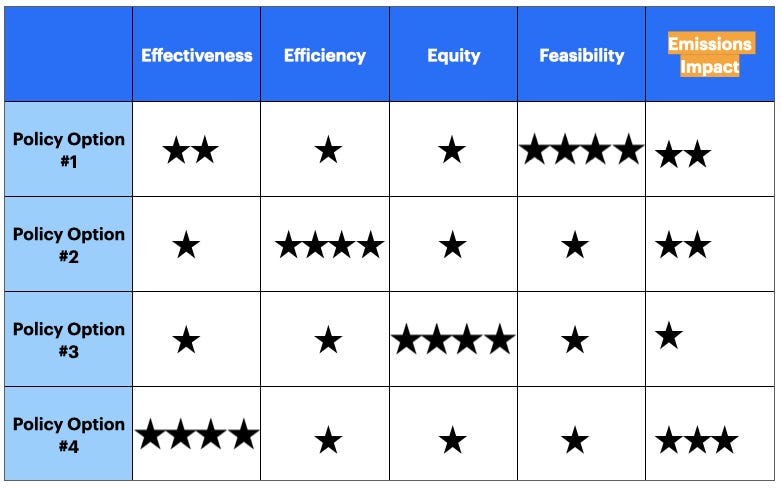
Bardach’s four canonical criteria for judging policy options are effectiveness, efficiency, equity, and feasibility. Confronting trade-offs across them is already difficult — no solution optimises all four. But India’s international climate commitments add a fifth: emissions impact.
The framework’s core claim is that emissions can no longer be treated as a specialised concern for environment ministries. It is now a cross-cutting evaluation parameter that must sit alongside the other four in every sector — agriculture, energy, transport, urban planning. The weight given to it may vary by context, but ignoring it is a cop-out.
Two pitfalls follow. One is unthinking transplantation of Western solutions — degrowth narratives, Malthusian population rhetoric — onto a country still raising incomes. The other is cynical fatalism: the claim that climate action is futile, which becomes a self-fulfilling prophecy.
Applied
- When comparing infrastructure projects where the cheapest option also has the highest carbon footprint.
- When evaluating agricultural subsidies that raise yields but increase methane or fertiliser emissions.
- When designing urban mobility schemes where equity (access for the poor) and emissions (clean vehicles) pull in different directions.
When it falls short
The fifth criterion adds complexity to an already contested trade-off space. Analysts may use it to justify pre-existing preferences rather than to discipline them. It also risks treating emissions as a scalar when the relevant metric — local pollution, global warming potential, adaptation resilience — varies enormously by sector.
Further reading
- Bardach, E. A Practical Guide for Policy Analysis. CQ Press.
- Original newsletter essay
Originally explored in A Framework a Week: No More COP-outs on Anticipating the Unintended.