Public Sector Reform
Most government organisations in India cannot be neatly classified. They sometimes perform all four functions at once. So, a key idea for government organisation reform is just to uncouple steering functions from rowing ones.
Origin
The framework comes from David Osborne and Peter Plastrik’s classic Banishing Bureaucracy. It was introduced in Anticipating the Unintended as a lens for understanding why Indian public sector reform so often stalls.
What it says
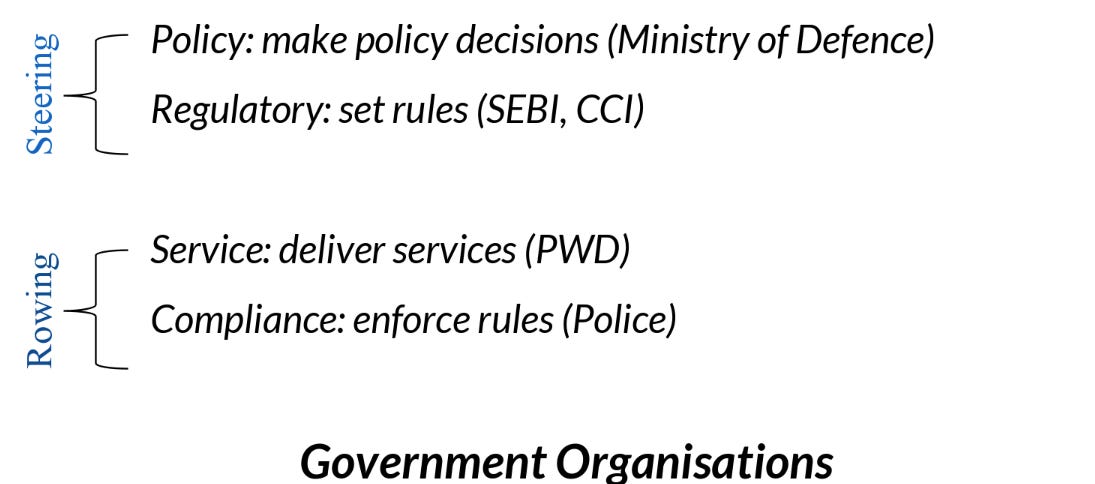
Government organisations perform four primary functions, which fall into two categories:
Steering functions (set direction): - Policy — setting rules and strategy. SEBI decides how capital markets operate. - Regulation — monitoring and enforcing compliance. Pollution control boards set emission standards.
Rowing functions (execute direction): - Service delivery — producing goods and services. Air India flew passengers; public schools teach children. - Compliance — enforcing specific orders. Traffic police issue fines; tax officials conduct raids.
The central insight is that steering and rowing should be uncoupled. Centralise steering so the state can coordinate direction; decentralise rowing so managers have the autonomy to improve execution. Most Indian organisations — the RBI is a prominent example — perform all four functions simultaneously, blurring accountability and diluting focus.
Applied
Privatisation is often misunderstood as an ideological choice. In this framework, it is simply the transfer of a rowing function (service delivery) from government to private operators, while steering (policy and regulation) remains with the state. Air India’s privatisation transferred rowing; the Civil Aviation Ministry retains steering.
The framework also explains why some privatisation efforts fail: when the state privatises rowing but retains neither the capacity nor the will to steer effectively, the result is regulatory capture or consumer exploitation. Conversely, nationalising steering functions (e.g., creating a unified financial regulator) can improve coordination without expanding the state’s operational footprint.
A creative application: reforming the CBFC (film censorship). The Takshashila Institution proposed converting the CBFC from a rowing organisation (it edits films) into a steering organisation (it licenses private Independent Certifying Authorities to rate films). Markets then plug the government failure.
When it falls short
Some functions genuinely require integration. A central bank needs both policy-setting (steering) and payment-system operation (rowing) to manage monetary transmission. Separating them may create coordination failures. Politics also resists uncoupling: rowing functions offer patronage, contracts, and jobs, which politicians are reluctant to surrender.
Further reading
- Osborne, D., & Plastrik, P. Banishing Bureaucracy.
Originally explored in A Framework a Week: Public Sector Reform on Anticipating the Unintended.