Taxonomy of Policy Failures and Successes
What we think of as implementation failures often turn out to be “theory of change” failures under the hood.
Origin
This is a meta-framework compiled in Anticipating the Unintended from multiple editions, drawing on Bovens et al., Patashnik, Allan McConnell, Kelkar & Shah, and Pritchett & Woolcock. It is designed as a diagnostic menu: whenever you witness a policy failure, one of these frameworks might help you classify it.
What it says
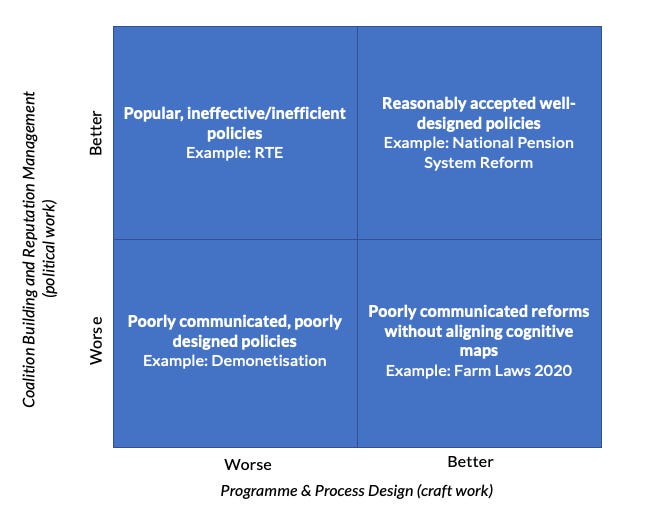
The taxonomy bundles six distinct diagnostic lenses:
1. The Programmatic–Political Axes Policies can be assessed on programmatic efficiency/effectiveness and on political coalition-building. A scheme can be technically sound but politically orphaned, or politically popular but technically hollow.
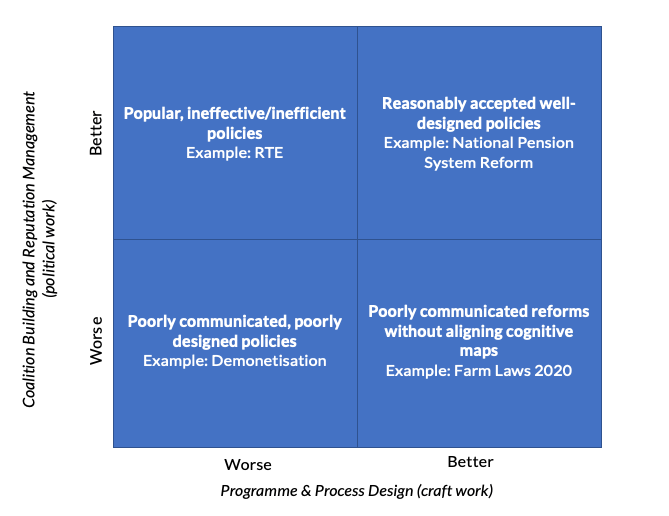
2. The Fourfold Measure Expands the two-axis view to counter narrative bias. Four assessment dimensions:
- Programmatic: effectiveness and efficiency.
- Process: implementation capability.
- Political: narrative power and coalition durability.
- Symbolic/Legitimacy: does the policy signal the right values?
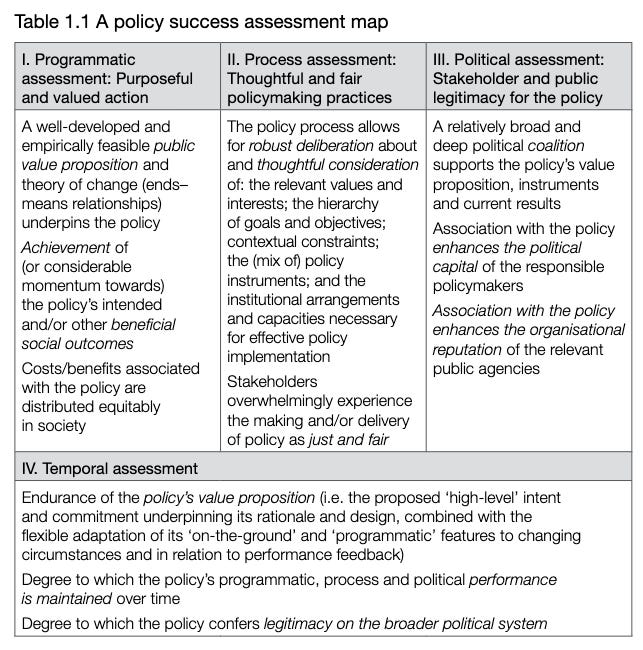
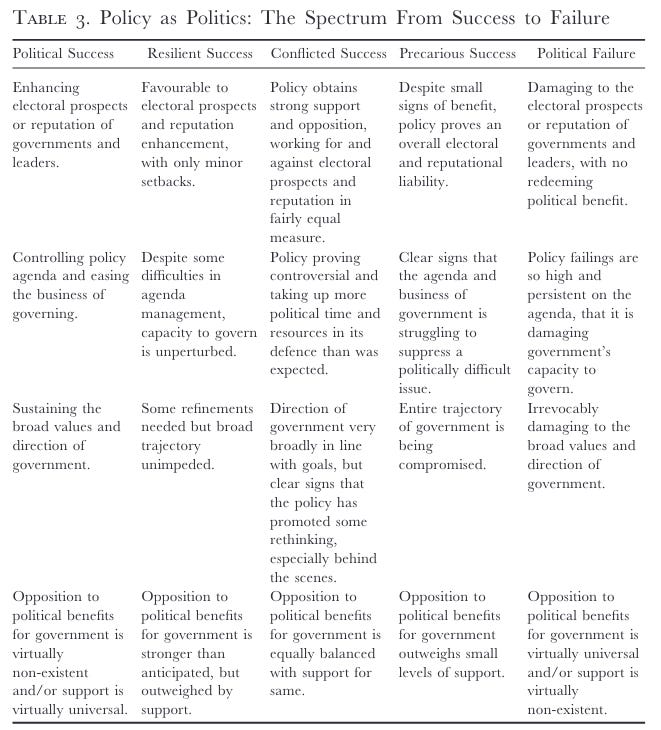
3. McConnell’s Spectrum Each dimension is graded from outright success → resilient success → conflicted success → precarious success → outright failure. A policy can be an outright success programmatically but precarious politically.
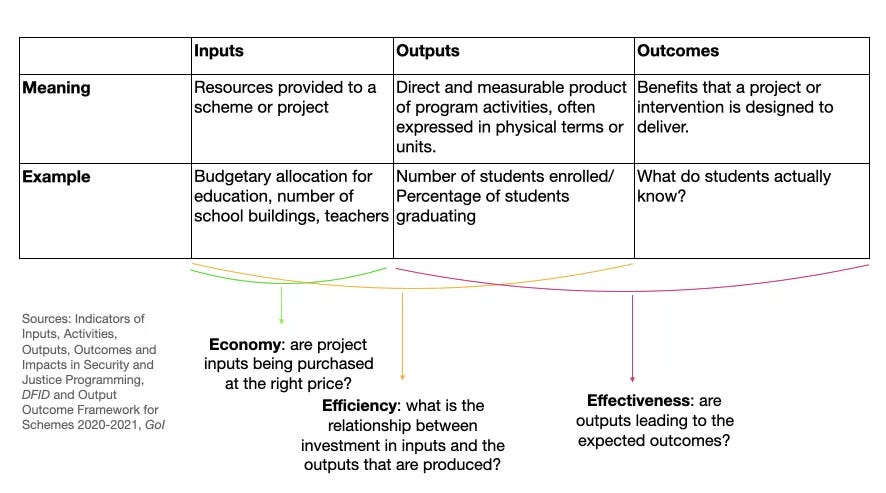
4. Outlays–Outputs–Outcomes (OOO) Breaks the chain: inputs → activities → impacts. A theory-of-change failure occurs when the assumed linkage is wrong (e.g., more school spending → better learning). An implementation failure occurs when the linkage is sound but execution breaks down.
5. Violating the Tinbergen Rule An institution asked to achieve many objectives with one instrument will fail on all of them.
6. Incentive Interference The mother of all failures: ignoring people’s preferences and incentives. Bans, price caps, sticky subsidies, and high tax rates are almost always counterproductive because they meddle with choice.
Applied
- Successful process, unsuccessful programme: Items reserved for manufacture exclusively by the small-scale sector followed parliamentary procedure but produced economic stagnation.
- Successful politics, unsuccessful programme: The Bombay Rent Control Act was electorally popular but destroyed rental housing supply.
- Successful programme, unsuccessful politics: The Civil Services Pension Reform of 2004 was technically sound, but five states have already reversed it for coalition-building reasons.
- Short-term success, long-term failure: Minimum Support Prices for grains and prohibition laws achieve immediate goals but produce adverse unintended consequences over time.
When it falls short
The taxonomy is neither mutually exclusive nor collectively exhaustive. Some failures span multiple categories. It can also become a checklist obsession: analysts classify without diagnosing, let alone prescribing. The frameworks tell you what went wrong; they rarely tell you how to fix it.