What Makes a Policy Chance Stick?
A swift policy change that is reversed and sent back to its original position is not paradigmatic reform. It is a faux paradigmatic move — and it leaves the system worse than where it started.
Origin
The framework comes from Benjamin Cashore and Michael Howlett’s work on super-wicked policy problems, particularly their 2012 paper Overcoming the Tragedy of Super Wicked Problems: Constraining our Future Selves to Ameliorate Global Climate Change. Pranay Kotasthane applied it to the Indian farm laws debate in the Anticipating the Unintended newsletter.
What it says
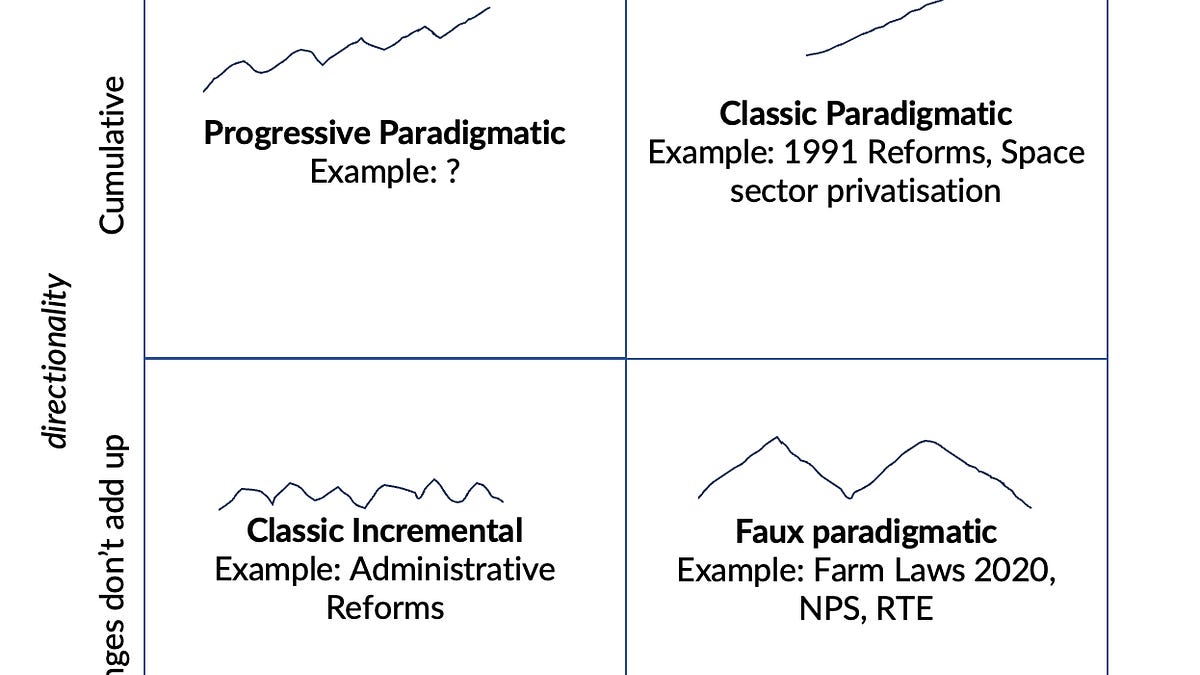
Cashore and Howlett map policy reform on two axes. The first is tempo: is the change incremental or paradigmatic (a step-jump)? The second is cumulative directionality: do changes add up to a new equilibrium, or do they fluctuate around the status quo?
The resulting 2x2 yields four reform mechanics. The upper quadrants — incremental and paradigmatic changes that accumulate — move the system to a new equilibrium. The lower quadrants represent change that does not stick. The farm laws of 2020 sit in the “faux paradigmatic” cell: a swift, paradigmatic change that was reversed, leaving the domain behind its starting point.
For reform to stick, three path-dependent processes must be triggered: - Lock-in: the intervention has immediate durability, making reversal difficult. - Self-reinforcement: the costs of reversing increase over time as support grows. - Positive feedback: support expands beyond the initial target population, reinforcing the original coalition.
Applied
- When designing structural reforms that will face intense opposition at launch and need to survive the first electoral cycle.
- When sequencing a reform agenda: front-load changes that create constituencies with a vested interest in the new equilibrium.
- When evaluating whether a celebrated “big bang” announcement has built any of the three sticky conditions.
When it falls short
The framework is better at classifying failed reforms than at prescribing successful ones. It does not tell you how to generate lock-in or positive feedback; it only tells you what to look for. It also treats politics as somewhat mechanical, when in reality stickiness depends on contingency, leadership, and events that no framework can plan for.
Further reading
Originally explored in A Framework a Week: What Makes a Policy Chance Stick? on Anticipating the Unintended.