Aap Hamaare Hain Kaun, Russia?
Strategic autonomy is a function of power. To gain more power, it’s better to partner with a stronger partner who can build your capability.
Origin
This framework was developed by Pranay Kotasthane in early 2022, as Russia-Ukraine tensions forced India’s strategic community to confront a long-festering question: what does the India-Russia relationship actually deliver? The title riffs on the famous Bollywood song to ask — in the language of realist international relations — what Russia is to India, and what India is to Russia.
What it says
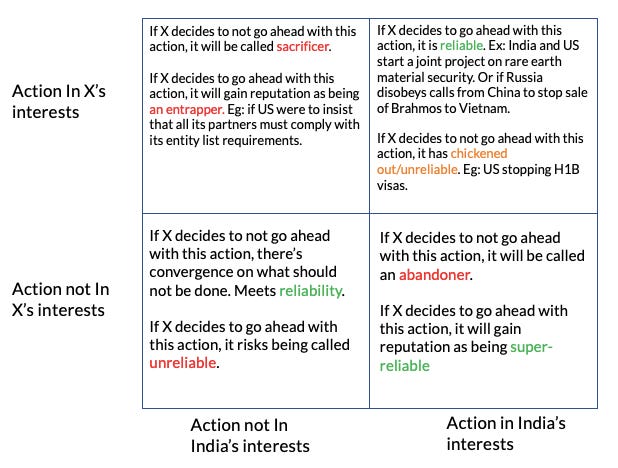
The framework addresses three persistent objections to rebalancing India’s foreign policy away from Russia:
Objection 1: Russia is necessary for strategic autonomy. The counter: autonomy is a function of power, not diplomatic equidistance. Partnering with a stronger partner (the US) who can build Indian capability increases autonomy; clinging to a weaker partner for the sake of proving independence is the opposite of strategic thinking.
Objection 2: Russia has been a reliable partner. The counter: reliability should be measured by impact on India’s interests, not sentiment. The 1971 Soviet deployment came after India had effectively allied with the USSR via the Indo-Soviet Treaty — it was reliable in a loose sense, not a self-sacrificing one.
Objection 3: India is dependent on Russian weapons. This is the only real constraint. The framework argues for two immediate responses: diversify the trade relationship so India can deter Russian denial of equipment through quid pro quo; and reduce defence dependence by buying from partners with whom India has broader partnerships.
A reliability-perception matrix sits at the heart of the framework: the strictest test of reliability is when a state takes self-harming action in India’s interest. By that test, Russia has rarely qualified.
Applied
India’s defence trade with Russia remains massively concentrated — around $10 billion annually, with the balance in Russia’s favour. India trades more with Venezuela, Belgium and South Africa than with Russia. This concentration is a vulnerability, not a strength.
The framework points to a clear rebalancing strategy: buy defence equipment from countries with whom India has broad and deep trade relations (the US, France, Israel); failing that, build such relations with the arms supplier. Russia falls into the latter category, and the bilateral relationship has not grown beyond the defence lane.
When it falls short
The framework correctly diagnoses the long-term problem but understates the short-term pain of transition. India’s military operates Russian-origin platforms across all three services; rip-and-replace is neither quick nor cheap. The framework also assumes the US will remain a willing and reliable supplier across sensitive technologies — an assumption that US politics periodically tests.