China’s Predicament
China is more powerful than ever before but is also more dependent on the world. This is an unprecedented combination, not known in Chinese history.
Origin
The framework comes from Ambassador Shivshankar Menon’s 2022 CSEP working paper Internal Drivers of China’s External Behaviour, adapted by Pranay Kotasthane for the A Framework a Week series. It captures a structural insight about China that is easy to miss: its unprecedented combination of high power and high dependence on the global system.
What it says
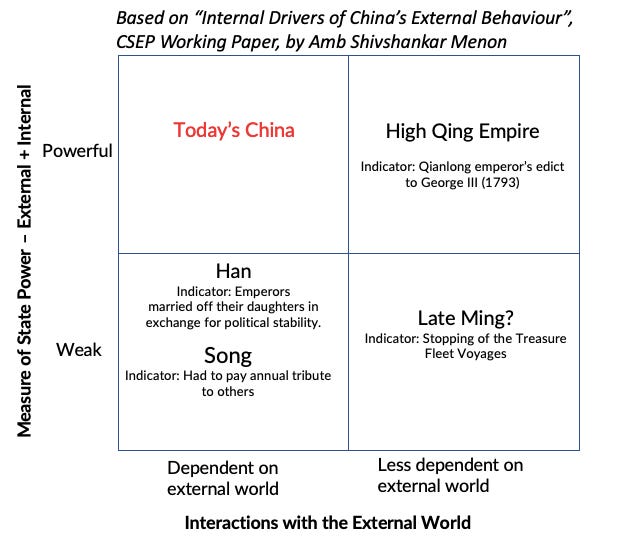
The framework can be visualised as a 2x2:
| Low dependence on world | High dependence on world | |
|---|---|---|
| High domestic power | Qing dynasty; self-sufficient empire | China today — unfamiliar territory |
| Low domestic power | Han dynasty; buying off the Xiongnu | Song dynasty; one among equals |
China’s predicament is that it finds itself in the high-power, high-dependence quadrant for the first time in its history. This explains much of its current external behaviour:
Belligerence in the Himalayas and South China Sea: High dependence on adversaries for technology and markets creates insecurity; high domestic power gives China the confidence (or over-confidence) to act assertively.
Drive towards self-reliance: The dependence on adversaries motivates a push for indigenous capability in semiconductors and other critical technologies. High domestic power gives China the fiscal and organisational capacity to attempt this at scale.
Muted retaliation to US export controls: China’s political establishment appears confident it can overcome dependence in due course, while taking advantage of the pressure to consolidate domestic capabilities.
Applied
For India, the framework suggests that China’s behaviour is not merely aggressive but structurally driven. It is not a temporary phase that will pass with better diplomacy. The high-dependence dimension means China is vulnerable to supply-chain disruptions and technology denial; the high-power dimension means it has the capacity to absorb pain and persist.
India’s strategy should account for both: exploit China’s dependencies where possible (semiconductor supply chains, critical minerals, maritime chokepoints) while not underestimating China’s ability to endure short-term costs for long-term gain.
When it falls short
The framework is a structural snapshot, not a predictive model. It does not tell us how long China can sustain the pain of decoupling, or whether its domestic power is as high as it appears. A severe economic slowdown or internal political fracture could shift China into a different quadrant. The framework also does not specify how India should calibrate its responses across different domains.