How Democratic States Perceive Each Other
While it may be true that two democracies are less likely to go to war, it is also far tougher to grow a budding partnership between two democracies in today’s open information environment.
Origin
This framework was developed by Pranay Kotasthane in the Matsyanyaaya section of Anticipating the Unintended, building on an earlier three-pillar model of bilateral relationships (state-to-state, state-to-people, people-to-people).
What it says
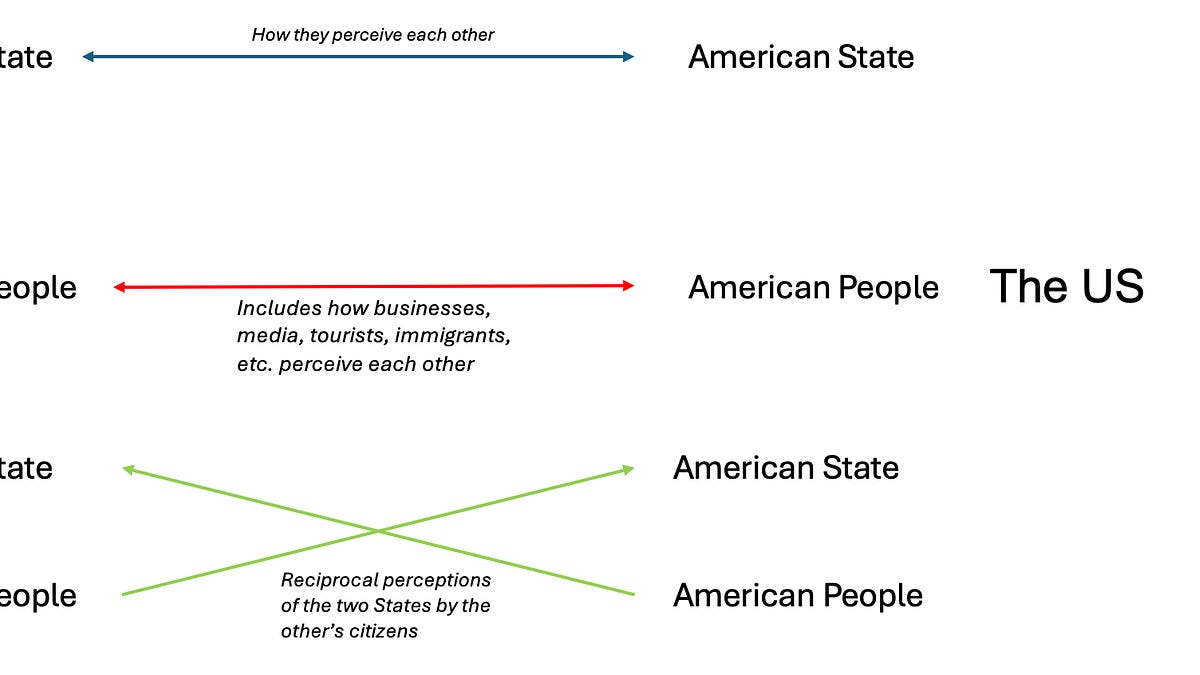
Any bilateral relationship has three pillars:
- State-to-state relations: The official diplomatic and strategic partnership.
- State-to-people relations: How each state’s government is perceived by the other state’s citizens.
- People-to-people relations: Cultural, economic, and educational ties between populations.
In the India-US case, the people-to-people pillar has always been the driving force, while state-to-state relations have improved significantly over the past decade. But the state-to-people pillar has always been the weak link.
The framework adds a crucial insight: in the Information Age, every issue is global by default, and cross-cutting narratives amplify the negative aspects of one state to the other state’s citizens. Indian narratives about the US as hypocritical and unreliable coexist with American narratives about India as a failing, oppressive democracy. Both are amplified by social media.
The corollary: for the partnership to be sustained, improvements on the state-to-state and people-to-people pillars must collectively exceed the downward drag from the state-to-people pillar.
Applied
For India-US relations, the framework explains why high-level diplomacy and diaspora warmth do not automatically translate into public trust. It also explains why authoritarian states have an asymmetric advantage: what Saudi citizens think of the US matters less because they cannot influence their regime’s foreign policy; and the Chinese state can control — to a limited extent — how it is perceived abroad.
The framework suggests that India and the US should invest specifically in the state-to-people pillar: transparent communication, pre-emptive briefing on sensitive stories, and consistent messaging that acknowledges disagreements without letting them dominate the narrative.
When it falls short
The framework treats democracies as a uniform category. In practice, a stable liberal democracy (the US, Germany) and a newer, less institutionalised democracy (India, Brazil) face very different state-to-people challenges. It also does not tell us how much investment in the other two pillars is needed to compensate for a deteriorating state-to-people pillar.
Further reading
- Kotasthane, Pranay. Matsyanyaaya: How do Democratic States Perceive Each Other? Anticipating the Unintended, 2024.
Originally explored in A Framework a Week: How do Democratic States Perceive Each Other? on Anticipating the Unintended.