Instruments of Technology Geopolitics
The old logic of technology geopolitics — keep your adversary dependent on your core technology so you can control their progress — has collapsed. Both sides are now racing to decouple.
Origin
This framework was developed by Pranay Kotasthane in a Takshashila Working Paper on high-technology geopolitics, and draws on Ansgar Baums and Nicholas Butts’ book Tech Cold War.
What it says
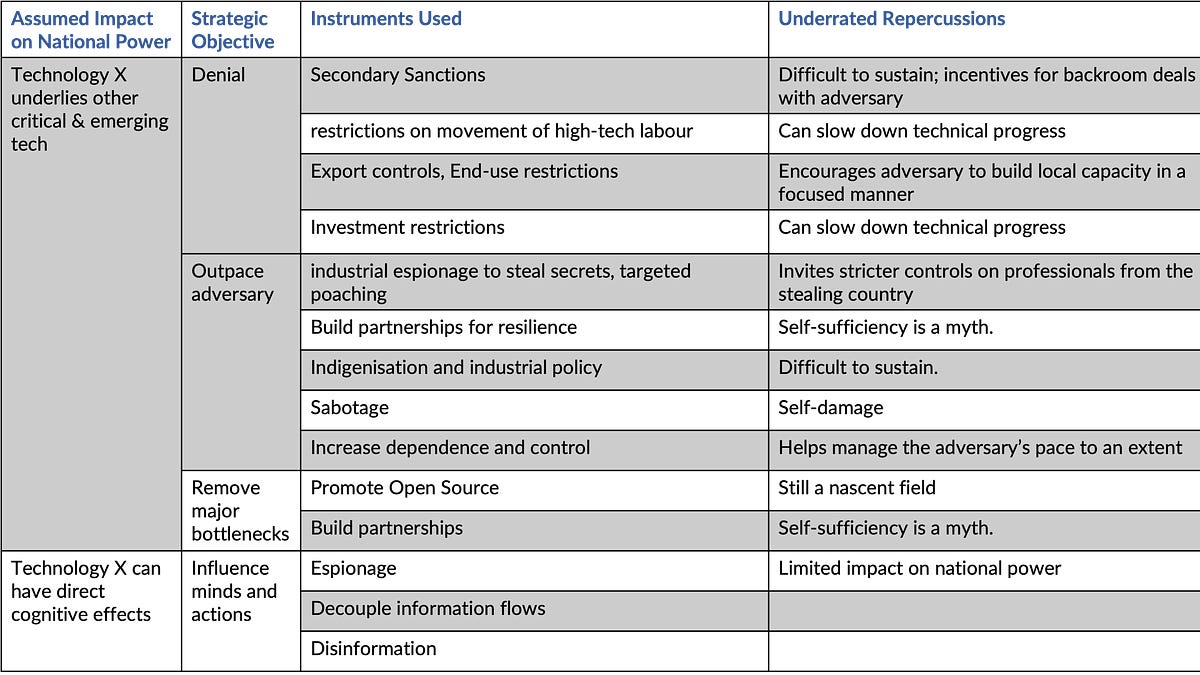
Nation-states deploy a range of politico-economic instruments in the technology domain. The critical shift of recent years is the abandonment of “dependence and control” as a strategy. As technology moved to the centre of geopolitics, the US and China both began blocking each other’s access to advanced chips, AI models, and critical minerals.
The book maps specific tools — export controls, investment screening, standards-setting, data localisation — to strategic ends, showing how the same instrument can be used for control, denial, or acceleration depending on context.
The unintended consequence is substitution: when OpenAI blocked Chinese users and the US blocked chip exports, China built DeepSeek. When China restricted rare earth magnets, the Quad launched a Critical Minerals Initiative. Export controls do not freeze competitors; they accelerate the development of alternatives, either domestically or through friendlier coalitions.
Applied
- When assessing whether a technology export control will constrain or accelerate a rival’s progress.
- When designing India’s semiconductor and critical minerals strategy.
- When reading the US-China tech war as a dynamic game rather than a static dominance map.
When it falls short
The framework moves quickly in a fast-evolving domain. It also assumes state-centric actors; private firms reorient themselves in ways that complicate national strategy. Finally, the substitution effect is not automatic — it depends on the targeted country’s scientific base and access to alternative supply chains.
Further reading
- Kotasthane, P. High-Technology Geopolitics in the Post-Pandemic World. Takshashila Working Paper.
- Original newsletter essay
Originally explored in A Framework a Week: Instruments of Technology Geopolitics on Anticipating the Unintended.