What Made the US Enable China’s Rise
Leaders of existing great powers are disinclined to expend considerable resources on an uncertain long-term threat. When existing powers focus on the short term, mutually beneficial cooperation with rising powers becomes more likely.
Origin
This framework comes from David Edelstein’s book Over the Horizon: Time, Uncertainty, and the Rise of Great Powers, adapted by Pranay Kotasthane for the A Framework a Week series.
What it says
Offensive realism argues that an incumbent great power should confront a rising power as soon as possible, regardless of the rising power’s intentions. Yet history shows the opposite: incumbents routinely enable their own future rivals.
Edelstein explains this divergence by adding two variables to relative power: perceived intentions and time horizons.
The framework can be visualised as a 2x2 of time horizons:
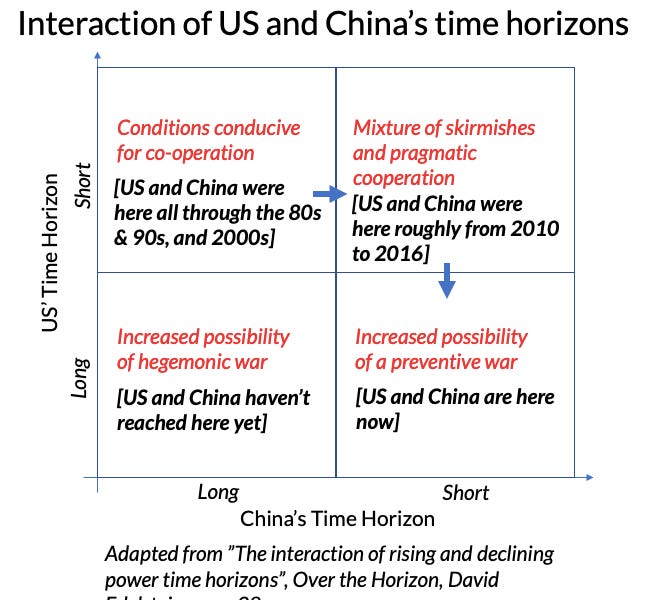
When a rising power has a long-term focus and the declining power has a short-term focus, cooperation is the equilibrium. This is what happened between the US and China after the Sino-Soviet split. China “hid its capacities and bided its time” (Deng Xiaoping); the US focused on short-term gains from cheap manufacturing.
By 2010, China’s time horizons changed. Its aggression towards neighbours signalled short-term consolidation. The US was still focused on the short term — Iraq, Afghanistan, Russia, Iran. Result: skirmishes and pragmatic cooperation.
By 2016, the US was forced to extend its time horizon. The result: preventive “war” — direct confrontation in trade and technology, though not yet by force.
Applied
For India, the framework explains why US support for China’s WTO entry and technology transfers was not a conspiracy or a blunder but a structurally predictable choice. It also warns that preventive confrontation is not inevitable: if China were to shift back to a long-term focus, the equilibrium could change.
The framework suggests that India’s own relationship with China should be calibrated by time-horizon analysis. Is China operating on a short-term or long-term horizon in a given domain? India’s response should differ accordingly.
When it falls short
The framework is better at explaining the past than predicting the future. Xi Jinping’s time horizon is opaque; the framework’s prediction of continued preventive confrontation assumes he remains short-term focused, which is debatable. It also does not account for domestic politics within the declining power — the US-China relationship is shaped by American electoral cycles as much as by strategic logic.
Further reading
- Ramanathan, Aditya. “Book Review: Over the Horizon.” Takshashila Institution.
Originally explored in A Framework a Week: What Made the US Enable China’s Rise? on Anticipating the Unintended.