Prisoner’s Dilemma in Policy Engineering
How do you get people to do something that is against their interest? Put them in what is known as the prisoners’ dilemma.
Origin
The framework comes from Avinash Dixit and Barry Nalebuff’s The Art of Strategy, applied to policy implementation by Anticipating the Unintended. The canonical example is Warren Buffett’s proposal for campaign finance reform, in which an “eccentric billionaire” threatened to donate $1 billion to the party that delivered the most votes for reform — turning incumbents’ self-interest against itself.
What it says
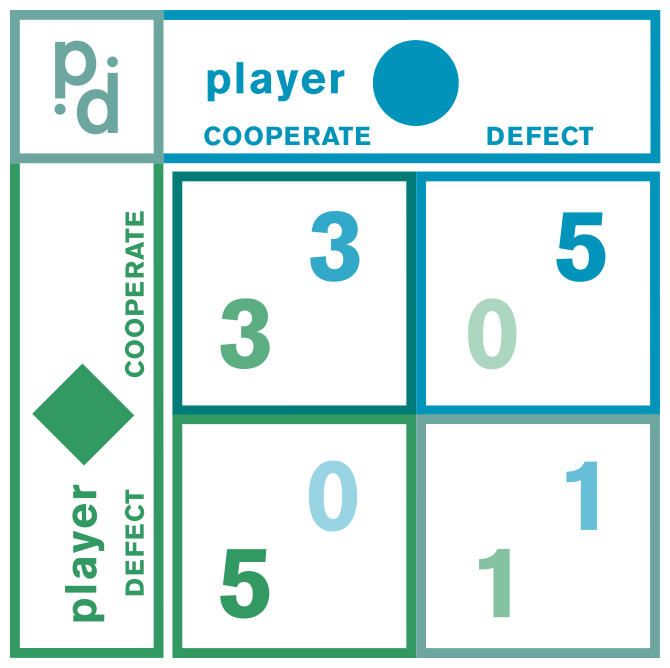
The core implementation challenge in public policy is this: effecting change often requires getting the most powerful stakeholder to act against their own interests. The traditional approach is persuasion or coercion. The game-theoretic approach is structural: redesign the payoffs so that the stakeholder’s self-interest now aligns with the reform.
The prisoner’s dilemma works because each player’s dominant strategy — the move that is best regardless of what the other does — leads to a collectively worse outcome. If you can embed the reform inside such a payoff structure, stakeholders will “voluntarily” support it.
The policy engineering toolkit has three steps:
- Identify the most powerful stakeholder(s) with strong personal interests in preserving the status quo.
- Design a prisoner’s dilemma that persuades them to seemingly act against their interests.
- Embed this dilemma in implementation rules so the outcome repeats across different players and contexts.
Applied
The Medical Council of India restricted doctor supply because incumbent doctors benefited from scarcity. Liberalising medical education required changing the MCI’s payoffs — for instance, by creating a competing accreditation body that would capture market share if the MCI did not reform, or by tying MCI funding to expansion targets.
Buffett’s campaign-finance example is the cleanest illustration. Without the billionaire’s threat, each party preferred the status quo (unlimited fundraising advantage). With the threat, each party’s dominant strategy flipped to supporting reform — because defecting while the other cooperated would hand the competitor $1 billion.
When it falls short
Constructing credible dilemmas is hard. It often requires leverage that reformers do not have — Buffett needed an “eccentric billionaire.” The dilemma must also be legally and ethically defensible; blackmail is not policy design. Finally, the framework assumes repeated or simultaneous interaction. In one-shot games, cooperation unravels.
Further reading
- Dixit, A., & Nalebuff, B. The Art of Strategy.
- Axelrod, R. The Evolution of Cooperation.
Originally explored in A Framework a Week: Making Prisoner’s Dilemma a Part of the Policy Engineering Toolkit on Anticipating the Unintended.